Cute Ocean Animal Clipart: A Designer’s Real-World Embroidery Review
First Impressions: Charm Without Clutter
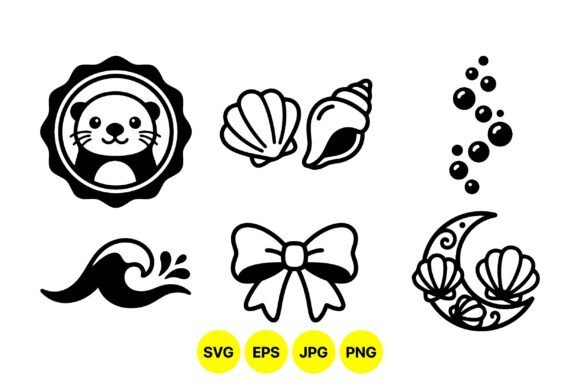
Opening the ZIP folder for Cute Ocean Animal Clipart, I immediately noticed how cleanly it balances whimsy and restraint. The otter face—centered in a soft round frame—is expressive but not overly detailed, with gentle curves and open, friendly eyes. Around it, seashells, a wave splash, a bow, and a shell-adorned moon orbit like quiet companions. It’s a black-and-white vector set, so there’s no color bias to second-guess—just strong outlines and intentional negative space. That’s gold for embroidery designers. This isn’t a busy illustration; it’s a thoughtful embroiderable idea. It reads as coastal but not kitschy, sweet but not saccharine—perfect for baby items, boutique kitchen towels, or a small-batch line of ocean-themed aprons.
What It Actually Stitches Like (Spoiler: Very Well)
I tested Cute Ocean Animal Clipart on a custom embroidered tote bag for a local nursery shop—a lightweight canvas with medium weave. Using a medium-weight cutaway stabilizer and standard 40-weight rayon thread, the design stitched out crisply. The round frame held its shape without distortion, and the otter’s facial features remained legible even at 3.2 inches wide. The seashells and wave splash translated beautifully into satin stitch borders and subtle fill stitch textures—no floating threads or skipped stitches. On a sweatshirt? I’d recommend keeping it under 4 inches and using tear-away + topping for that brushed surface. On baby onesies? Absolutely viable—if digitized thoughtfully (more on that below).
Where It Shines—and Where It Needs Care
- Best fits: Tote bag design, sweatshirt embroidery, tea towel monograms, embroidered patch backings, pillow covers, holiday embroidery (think “ocean-themed baby shower gift”), and nursery decor. Its circular layout makes it ideal for center-chest placements or framed hoop art.
- Use carefully on: Stretchy fabric (like jersey), thin cotton (risk of show-through), dark fabric (test contrast with light thread), and curved surfaces like caps—where the round frame may warp slightly if hooping isn’t precise. Tiny corners (e.g., corner of a handkerchief) aren’t ideal—the composition needs breathing room.
- Avoid for: Dense applique design work requiring intricate layering, ultra-fine lettering integration, or high-stitch-count commercial embroidery runs where fill density could cause puckering on lightweight fabrics.
Real Project Moment: The Baby Shower Tote Bag
Last week, I used Cute Ocean Animal Clipart on a linen-cotton blend tote for a client’s baby shower order. She wanted something gender-neutral, nature-inspired, and handmade-feeling—not mass-produced. We chose soft seafoam thread for the otter’s face and creamy ivory for the shells. The result? Customers paused at the booth. Not because it was flashy, but because it felt *considered*: the round frame echoed the shape of a onesie fold; the wave splash suggested gentle movement; the shell-moon added quiet detail you notice only up close. That’s the quiet power of this set—it builds emotional resonance without shouting. For Etsy sellers and craft fair vendors, that kind of subtle storytelling lifts perceived value and encourages repeat buyers.
Design Integrity Meets Commercial Practicality
As a designer who supplies embroidery files to small shops and digital product sellers, I pay close attention to how a graphic holds up across use cases. Cute Ocean Animal Clipart delivers consistency: it works equally well as a machine embroidery design for stitching and as clean Illustrations for printable mockups or digital product previews. Its vector origin means scaling is lossless—critical when adapting for a tiny cap front versus a large pillow cover. And because it’s black-and-white, it avoids the trap of “color-dependent charm.” You’re not locked into one palette; you’re invited to interpret it. That flexibility matters for craft business owners juggling multiple product lines.
Practical Notes Every Embroidery Designer Should Check
- Test the design on scrap fabric first—especially if using textured or stretchy materials.
- Review stitch density: high-fill areas (like the otter’s fur texture) may need reduced density on delicate fabrics.
- Confirm hoop size compatibility—its circular layout suggests a 4×4 or larger hoop for best clarity.
- Inspect small details: the shell contours and bow loops should remain distinct at your target size.
- Try black-and-white mockups on both light and dark backgrounds—this design gains strength from contrast.
- Use proper stabilizer: cutaway for knits, tear-away for stable wovens, topping for napped surfaces.
- Verify licensing before selling finished products or bundling as part of a digital embroidery file pack.
Final Thought: It’s Not Just Cute—It’s Cohesive
“Cute” gets overused in embroidery marketing—but Cute Ocean Animal Clipart earns the word. It’s cute with intention. It doesn’t rely on trend-driven clutter; instead, it leans into rhythm, balance, and quiet narrative. That’s why it works so well for personalized gifts, custom apparel, and small shop merchandise: it feels handmade, not algorithm-generated. For embroidery designers building a signature style—or Etsy sellers curating a cohesive brand voice—it’s not just another Graphics download. It’s a reliable, mood-aligned design asset that helps your finished product feel like a promise kept: gentle, grounded, and full of care.